Skip to content

Buy 2 jars, get the 3rd free. Free EU shipping included. Choose your jars

The complete explainer · 6 minute read

What is shilajit, actually

Everything on this page is checkable. Where the evidence is strong we say so, where it is thin we say that too. By the end you will know what shilajit is, how it forms, how people take it, and what the research does and does not show.

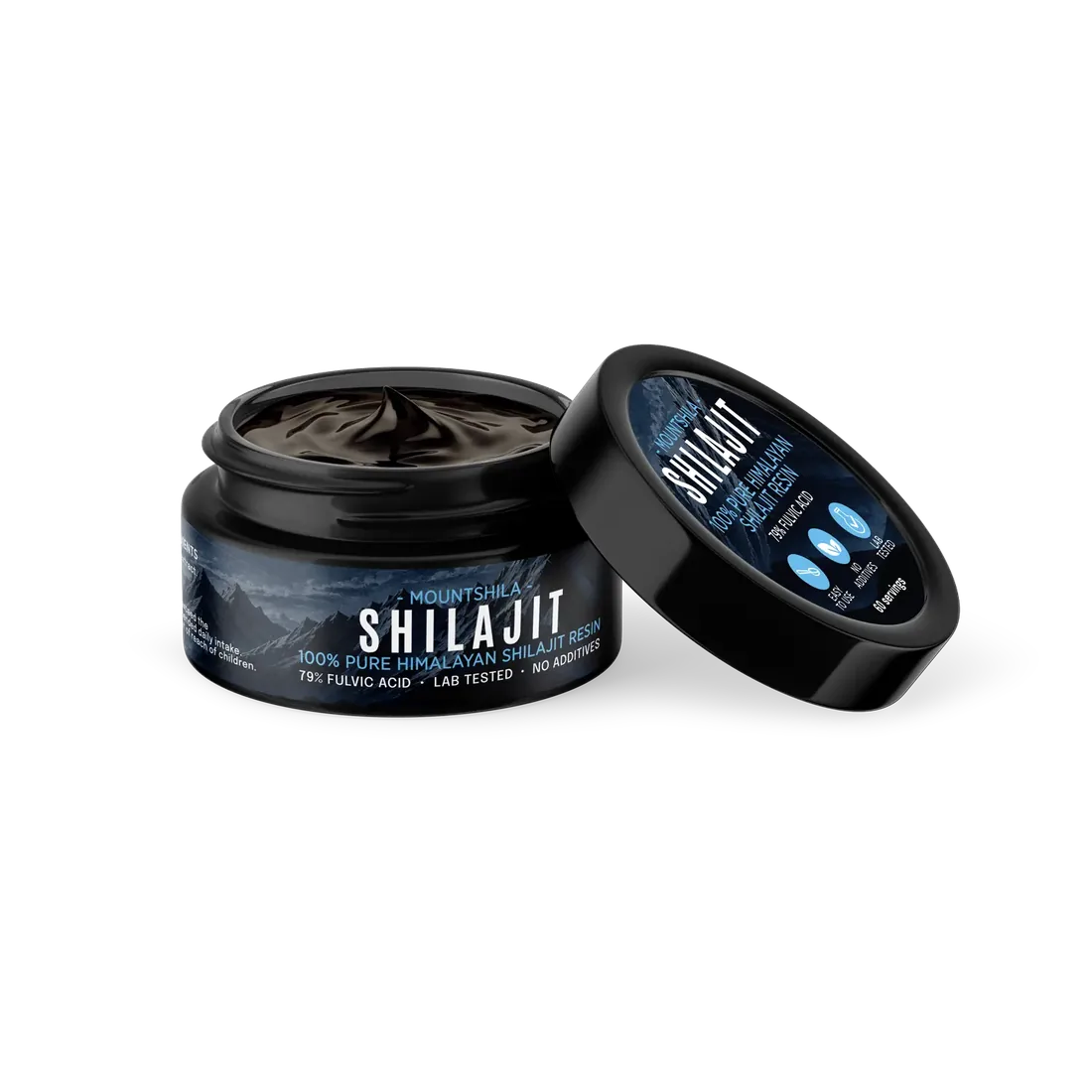
Jar of Shilajit Pure resin

Chapter 1

Not a plant. Not a mineral. Both.

Shilajit is a blackish-brown resin that seeps from layers of rock in high mountain ranges, most famously the Himalayas. It forms where ancient plant matter has been compressed and transformed inside the rock.

Chemically it is a phyto-mineral complex: humic substances (including fulvic acid), trace minerals and amino acids in one material. At room temperature it is soft and tar-like. Warm it slightly and it flows; cool it and it becomes brittle.

Chapter 2

How it forms

Many brands claim shilajit takes "millions of years" to form. The geological evidence supports centuries to millennia. Still remarkable. No exaggeration needed.

Macro of mineral-rich shilajit resin and rock
01
1 · Plant matter

Mosses, lichens and other high-altitude plants are trapped in rock layers as mountains form and shift.

02
2 · Transformation

Over centuries to millennia, pressure, temperature swings and microbial action break the plant matter down into humic substances.

03
3 · Seepage

In summer, warmth softens the resin and it seeps out of rock crevices, typically between 1,000 and 5,000 metres altitude.

04
4 · Collection

Raw resin is collected by hand. At this stage it still contains rock dust, plant debris and possible contaminants. Purification comes next, and it decides everything.

Why quality matters

Chapter 3

What is in it

Composition varies by source and purification, which is why testing each batch matters. These are figures from our available Eurofins test.

~79%
Fulvic acid

The most-studied fraction of shilajit and the number quality is usually judged by. Measured by gravimetry.

4.6 g
Humic acid per 100 g

The broader family of humic substances that give the resin its dark colour and density. Measured by titrimetry.

84+
Trace minerals reported

Literature reports a wide mineral spectrum in ionic form. Exact profile varies by source region and batch.

1
Ingredient

Pure is shilajit resin and nothing else. Orange and Strawberry add a natural flavour plus the other ingredients listed on their labels.

Chapter 4

Resin, powder or capsules

Shilajit is sold in three forms. The differences are about processing, not marketing. We sell resin because it is the least processed form.

Resin
What we sell
Processing: minimally processed, filtered and concentrated, not dried or milled.
Typically added: nothing.
Dose control: you portion it yourself, 500 mg at a time.
Verifiable: a resin certificate tests the thing you actually eat.
Powder
Processing: resin is dried at temperature and milled. More steps, more heat.
Typically added: drying carriers such as maltodextrin, often undeclared in the headline.
Dose control: depends on how diluted the powder is.
Verifiable: only if the certificate covers the finished powder, not the input resin.
Capsules
Processing: powder pressed or filled into capsules. The most processed form.
Typically added: fillers, flow agents and the capsule shell.
Dose control: fixed per capsule; actual shilajit content varies widely by brand.
Verifiable: hardest to check. The label mg and the resin-equivalent mg are rarely the same number.
Shilajit resin, powder and capsules side by side comparing formats

None of this makes powder or capsules bad products. It means they have more steps between the rock and you, and each step is something a certificate needs to cover.

Chapter 5

How you take it

About 30 seconds, twice a day.

A hand stirring shilajit resin into a glass of warm water
Portion

Take a rice-grain-sized portion, about 500 mg, with the measuring spoon or a clean utensil.

Dissolve or take direct

Stir it into coffee, tea or warm water until dissolved, or let it melt under your tongue.

Twice daily

Once in the morning, once in the evening. Do not exceed the recommended daily intake.

Keep out of reach of children. If you are pregnant, nursing or on medication, consult your doctor before use.

Chapter 6

What the research actually shows

We grade every topic by the strength of its human evidence. No EFSA-authorised health claim exists for shilajit, so we make none. Where the evidence is thin, we say so.

Preliminary: one or two small human trialsLimited: inconsistent or indirect evidenceUnknown: no adequate human trials
Research desk with a notebook, magnifying glass and a dish of shilajit resin

Testosterone markers

Preliminary

Direct answer: one randomised, double-blind, placebo-controlled trial (Pandit et al., 2016) gave 250 mg purified shilajit twice daily to healthy men aged 45 to 55 for 90 days and reported significantly increased total and free testosterone versus placebo.

Why we grade it preliminary: it is a single study with a small sample, in one age group, and it has not been independently replicated. A promising signal is not the same as an established effect.

Source: Pandit et al., Andrologia, 2016 · dose used: 2 × 250 mg/day

Fatigue & exercise recovery

Limited

Direct answer: a small number of trials (including Keller et al., 2019, on muscular fatigue) suggest possible effects on fatigue-related markers, but samples are small and results inconsistent across studies.

Why we grade it limited: study designs, doses and outcome measures differ too much to support a firm conclusion. More and larger trials are needed before anyone should buy shilajit primarily for this reason.

Source: Keller et al., Journal of the International Society of Sports Nutrition, 2019

Cognition & longevity

Unknown

Direct answer: no adequate human trials exist. Published work (e.g. Carrasco-Gallardo et al., 2012) is preclinical or theoretical. These are cell and animal studies that propose mechanisms, not demonstrations of effects in people.

Why we grade it unknown: mechanisms proposed in a dish are routinely not confirmed in humans. Any brand claiming cognitive or longevity benefits from shilajit is running ahead of the evidence.

Source: Carrasco-Gallardo et al., International Journal of Alzheimer's Disease, 2012 (preclinical)

Safety & heavy metals

Well documented

Direct answer: the documented safety risk in this category is not shilajit itself but raw, unpurified or adulterated product, which can carry lead, arsenic and other heavy metals. This is why purification and independent testing matter more than any benefit claim.

Our answer to it: MountShila resin is screened by Eurofins for arsenic, cadmium, mercury and lead by ICP-MS. Do not exceed the recommended daily intake. If you are pregnant, nursing, or on medication, consult your doctor first.

How each test works: see the Quality page

Tradition, kept separate

Historical record

Direct answer: shilajit has been used traditionally in Ayurvedic medicine as a rasayana. That is a documented historical fact about how it has been used, not evidence that it works.

We keep tradition and science in separate sentences on purpose. Centuries of use tell you about cultural importance and observed tolerability, not about efficacy. When the two blur into one sentence, that is marketing, not evidence.

Our standard for this chapter. Every topic above is graded against human-trial evidence only. Preclinical findings are labelled as such. This page is reviewed against the current literature and updated when new trials publish. Last reviewed July 2026. Nothing here is medical advice.

32 articles and counting

Browse the whole library

Filter by topic, or start with whatever question brought you here.

You now know more than most buyers

Next: why quality decides everything

The difference between shilajit products is not the story on the label. It is what happens between the rock and the jar, and whether anyone checked.