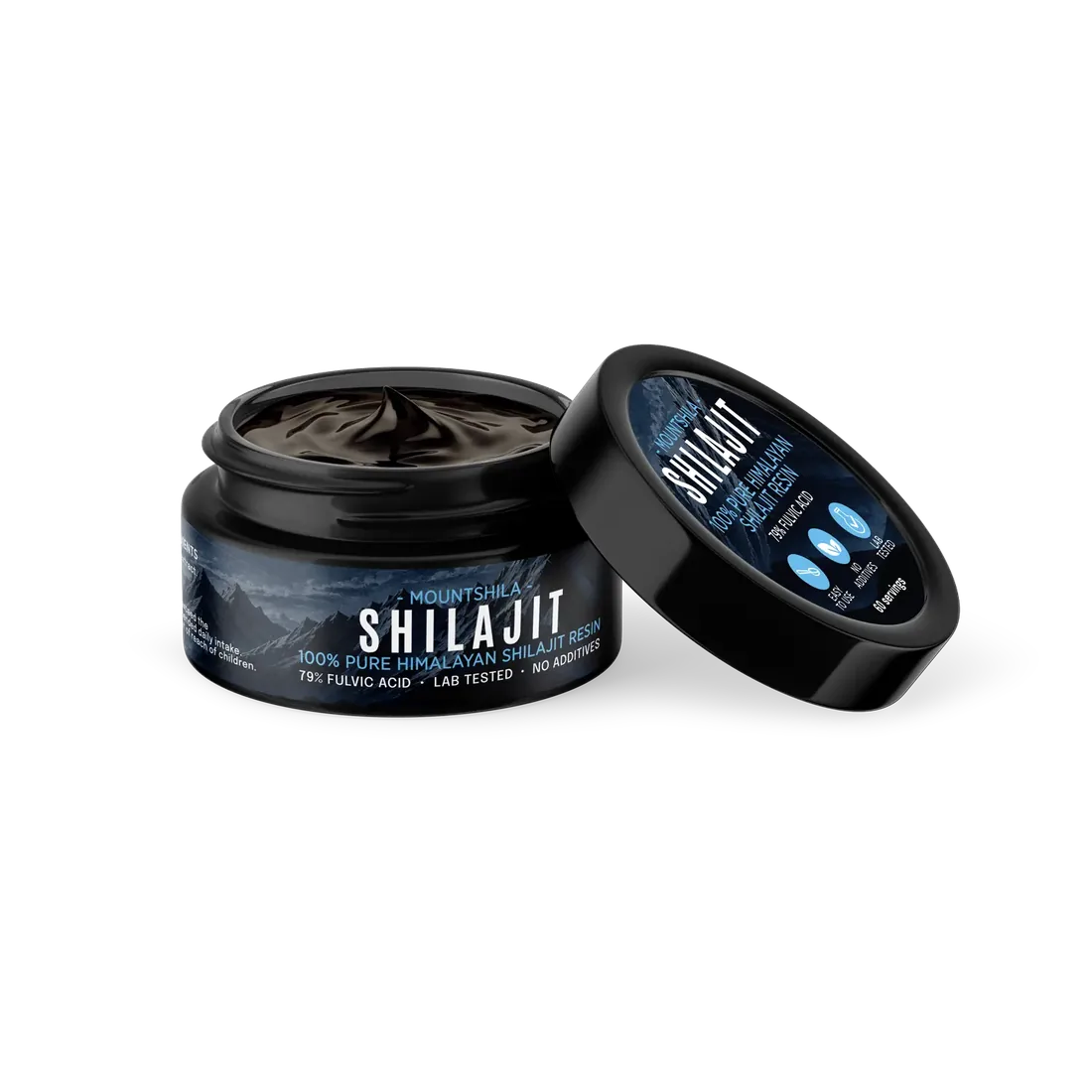


Shilajit is sold in three main forms: resin, powder, and capsules. They are not simply the same product in different packaging - the processing behind each one changes what you can actually verify about what you are taking.
Resin
Purified, unprocessed-beyond-purification shilajit in its natural, tar-like form. This is the least altered form of the three: no drying agents, no fillers, no capsule shell material. A lab report tested against resin is testing the same substance you actually consume, with nothing added in between. It is also the least convenient to dose precisely by eye, which is why a standard rice-grain-sized serving (about 500 mg) is the usual guidance rather than a printed number on each dose.
Powder
Resin that has been dried and ground into a powder, sometimes with a drying or anti-caking agent added to keep it from clumping. Powder is more convenient to measure and mix into drinks than resin, but the drying process is an additional processing step, and any added drying agents are additional ingredients beyond shilajit itself. Whether a specific powder product includes such additives depends entirely on the brand, so checking the ingredient list matters more with powder than with resin.
Capsules
Shilajit powder or extract packed into a capsule shell, which is the most convenient form to dose and travel with, since there is no measuring or dissolving involved. The tradeoffs are a capsule shell (an additional ingredient, sometimes gelatin, sometimes a vegetarian alternative) and, in some products, an extract or concentrate rather than the whole resin - which changes what a lab report is actually verifying. Extract ratios and concentration claims on capsule products are worth checking carefully, since "extract" can mean very different concentration levels between brands.
Which form is actually "best"
We are not aware of research comparing effectiveness between the three forms directly. The honest differentiator is not proven superiority of one form over another, but verifiability and processing: resin is the least processed and easiest to verify against a lab report testing the exact substance you consume, capsules are the most convenient but add a shell and sometimes an extraction step, and powder sits in between. MountShila sells resin specifically because it is the form our own testing philosophy is built around - see our Certificate of Analysis guide for what that verification actually looks like.
Convenience versus verifiability
If convenience matters most to you, capsules are the practical choice, provided the brand discloses its extract ratio clearly. If verifiability and minimal processing matter most, resin is the more transparent option. Neither claim is about which one "works better," because we are not aware of evidence establishing that.
Sources and further reading: