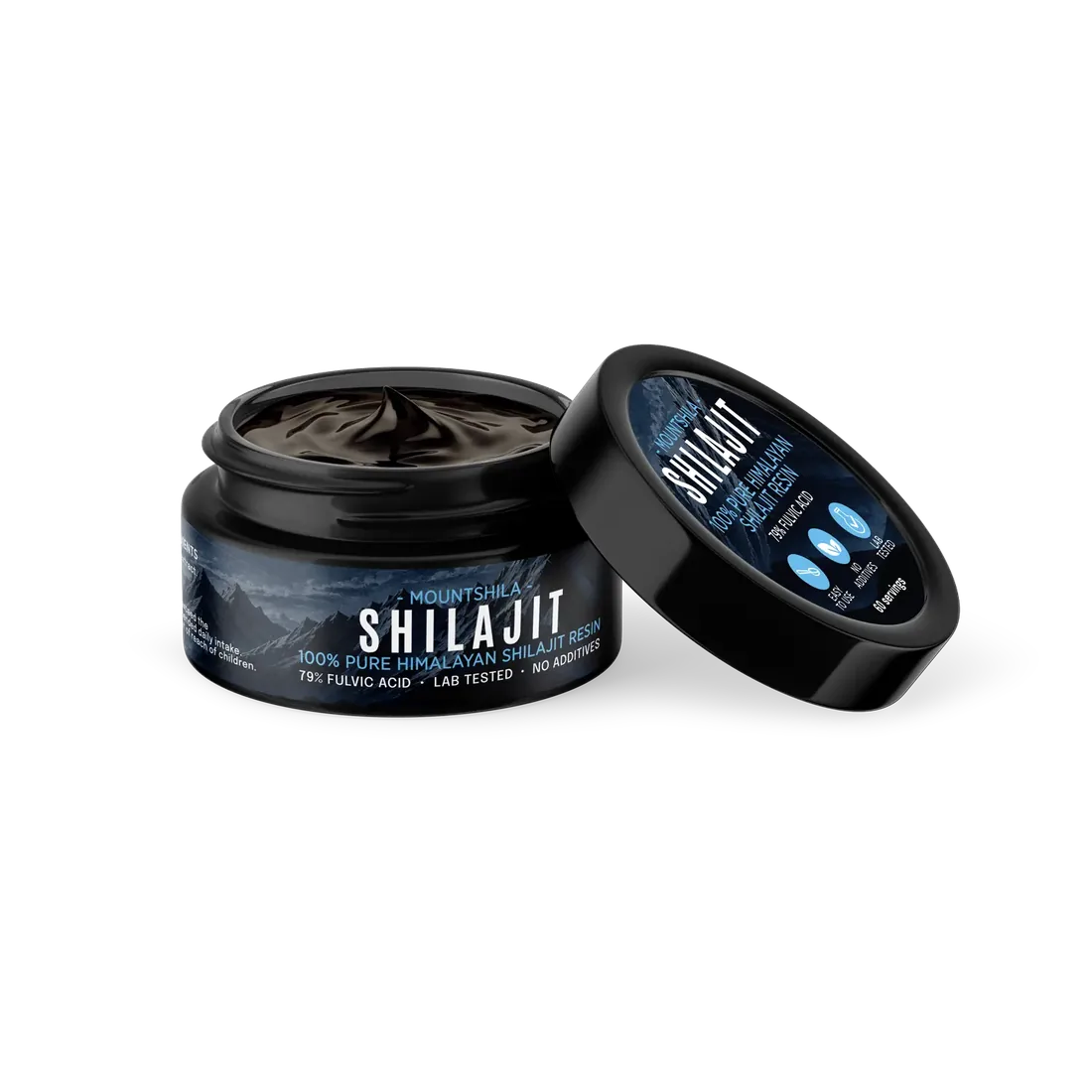


"79% fulvic acid" is the single most repeated number in shilajit marketing, including our own. This page explains what fulvic acid actually is, where it comes from, what is well established about it, and what is not.
What fulvic acid is, chemically
Fulvic acid is not one specific molecule. It is a broad class of organic compounds that form during humification, the process by which plant and microbial matter breaks down over long periods of time into humic substances. It is found wherever this process happens: in soil, in compost, in peat, and in shilajit, which forms as ancient plant matter is compressed and transformed inside high-altitude rock over centuries to millennia. Fulvic acid is defined by its behaviour, not a fixed formula: it is the fraction of humic substances that stays soluble across the full pH range, which is also why it is measured by gravimetry (recovering and weighing what remains after that solubility test) rather than a simple chemical assay.
Humic acid, its close relative
Shilajit also contains humic acid, a related but chemically distinct humic substance, generally larger in molecular size and less broadly soluble than fulvic acid. Fulvic acid and humic acid together, present in specific measurable ranges, are what a laboratory looks for to confirm a resin is genuine shilajit rather than a diluted or synthetic substitute. Neither number alone tells the whole story; a certificate that reports the fulvic acid percentage without the humic acid figure is only telling you half of what defines the resin.
What is well established, and what is not
The chemistry above, how fulvic acid forms, what it is, how it is measured, is standard soil and humic-substance science and is not disputed. What is far less settled is what happens after you eat it. A well known property of fulvic acid, documented in soil and agricultural science, is chelation: fulvic acid molecules can bind to metal ions and minerals. This is well established in soil chemistry. Whether and how that property translates into an effect inside the human body is a separate question, with a much thinner evidence base, and one we are not going to round up. No EU-authorised health claim currently exists for fulvic acid or for shilajit, so we make none. What the available human research does and does not show, graded honestly, is covered on our What is shilajit page.
Why the percentage on the label still matters
Even without a settled physiological claim, the fulvic acid and humic acid percentages remain useful for a different reason: they are the closest thing this category has to a verifiable authenticity marker. A resin that tests low on both, or reports neither, has not demonstrated it is genuine, concentrated shilajit rather than a diluted or padded product. That is what the number is actually good for: confirming what is in the jar, tested by an accredited lab, method named, not a shortcut to a health outcome.
Our own resin tests at approximately 79% fulvic acid and 4.6 g/100 g humic acid, measured by Eurofins Food Testing Netherlands. See the full result and how to read it in our certificate of analysis guide.
Sources and further reading:
- Stevenson, F.J., Humus Chemistry: Genesis, Composition, Reactions (2nd ed.), on humification and the fulvic/humic acid fractionation
- See also: Understanding a shilajit certificate of analysis
- See also: What is shilajit, actually